This is a translated excerpt of the original Spanish article in El Mundo, written by Daniel Arjona.
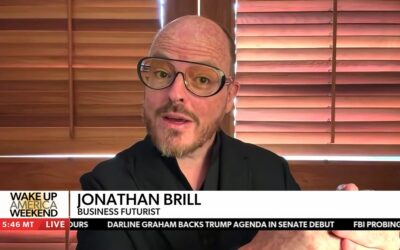
Jonathan Brill, futurist: “In the next five years, five AI-driven trends will collide in the world.”
The American futurist and author of ‘AI and the Octopus Organization’ places the new technology within a larger framework in which five fronts collide simultaneously: debt, demographics, military spending, trade disharmony, and AI.
The stagecoach driver in the Wild West, sitting on the driver’s seat, didn’t guide the horse. The horse, Jonathan Brill asserts, knew the way and where to find food. Horses aren’t stupid. The driver’s job was to handle extreme situations, secure the cargo, and react when something went wrong. The same description, with minor adjustments, applies today to the American truck driver, the drone operator, and, one suspects, almost any profession in the next five years. Automation takes away the repetitive tasks, yes, but the rest endures. The interesting part comes when you step back from the specific job and look at what’s happening around you.
Jonathan Brill (Boston, 1974) presents himself as a “futurist” with 25 years of experience in technology. He directed R&D labs for two decades, served as HP’s global futurist, and today advises nation-states and Fortune 500 companies on five-year strategic horizons. Forbes presents him as the world’s most influential futurist, a label he qualifies by pointing out that he only works with what is knowable within a five-year timeframe. His book, AI and the Octopus Organization (Almuzara Publishing), begins with a stark image of the ocean: the 30-meter wall of water that appears out of nowhere when two undertow currents collide. Brill catalogs five currents capable of generating such waves and proposes a five-step method to avoid sinking to the bottom when one forms.
Brill traveled to Madrid to give a lecture at Accenture’s headquarters, organized by Dircom. Addressing a room full of communications executives, he spoke about the five currents that are already colliding, warned against viewing AI in isolation, argued that the pending transformation is sociological rather than technological, and proposed replacing the 19th-century “great man” hierarchy with the distributed intelligence of the pulp fiction, or that animal whose arms think for themselves and consult the central brain only when necessary.
Question: Futurists are often accused of turning uncertainty into dramatic narrative. Give me a falsifiable prediction: what measurable signs before 2030 would prove you right, and what would force you to admit that that giant wave was more narrative than reality
Answer: Regarding your first point, the same could be said of journalists. There are quite a few futurists spouting empty rhetoric out there, so I’m not sure who we’re referring to. There is a group of us who work with multi-billion dollar investments and national security. That’s my line of work, and we always operate on strategic issues. We do this by identifying the range of possibilities, not a specific future. We do this through primary and secondary research on what is knowable, combining inductive, deductive, Bayesian, and abductive reasoning. We then assess the likelihood of these possibilities, often through statistical or consensus-based decisions. If you’d like to examine my working process, here’s a copy of my book on decision-making under uncertainty. Most of my work is based on various forms of IPO (input, process, outpu ) analysis and Systems Dynamics. If you want to delve deeper, this is the best book on the subject. I can’t tell you what will happen in 2040 beyond the major secular trends that the World Bank and similar organizations work with. I only focus on what is likely to happen in the next five years, and I’ll cite five AI-driven trends that are likely to collide globally.
Tell me about those five trends.
Trade disharmony: The United States will have a protectionist president for a time, and by 2030 the rest of the world will have reoriented itself.
Demographics: Europe’s aging population limits production and consumption, and compensating for this has historically required either colonialism or innovation; Europe lacks the military capacity for the former and underperforms in the latter.
Economic uncertainty: With global debt rising and international coordination broken, the next crisis could dwarf that of 2008.
Military spending: Bloomberg projects a 50% increase between 2025 and 2030, and these weapons need to be tested in the field (the “exquisite” weapons in Iran, the Discombobulator in Venezuela, Ukraine as a testing ground).
And the improvement of AI: Models reduce their value per dollar by between 9 and 900 times per year, so a 32-fold improvement in five years seems feasible. If the EU formulates a coherent policy, if the powerful become hippies, if peace erupts, or if AI slows down in the face of Arc-AGI or Humanity’s Last Exam, my numbers could be wrong. We don’t know when or what will cause these trends to collide. It could be Iran, it could be a natural disaster, or the assassination of Archduke Franz Ferdinand, but do you really think these dominoes won’t fall?
You scoff at products claiming to have “AI built in,” yet you also argue that agentic AI will transform complex workflows: patents, design, finance, HR, operations. Where is the line between a genuinely agentic tool and a Silicon Valley demo? What level of reliability, traceability, and auditability would you demand before allowing an agent to touch pricing, contracts, patents, or hiring decisions?
I did make fun of a pack of chewing gum that claimed to have AI inside, yes. I think tools like ChatGPT 5.5 Pro and Opus 4.7 Adaptive are starting to make the leap to utility. We’ll probably see enterprise-grade tools generating economic value in the next year, scaling up towards 2030 as more data center capacity comes online and the tools become more energy-efficient and mature. I’m Head of Invention at Deep Invent, which was just granted a patent developed by our AI in less than four months, so I already have direct experience with patents. As for pricing, we’ve had AI-powered dynamic pricing in online commerce for years. In development, we’re starting to see these tools used to improve the accuracy of offers, still with a human in the loop. Regarding traceability and auditability, it depends on the type of application. To help people clarify and structure their thinking, the most advanced tools (and less than 1% of people use the most advanced tools) are already very good at this point, specifically ChatGPT 5.5 Pro. If you’re using the free versions, they’re probably not up to par yet. Regarding reliability, I know you’re trying to catch me out with this question, but based on the application, the tools at this level are quite good right now.