Originally published on CIO and co-authored with Steve Wunker
Stop obsessing over AI tools. The real win is reshaping your org so humans and machines decide faster together — like an octopus, not a rigid shell.
Anxious executives often ask the same questions about AI: Which AI platform should we invest in? How do we prevent hallucinations? What about data security?
These are reasonable concerns, but they miss the point entirely. The question you should be asking isn’t technological but organizational: How can we restructure our organization so humans and machines, together, can sense, decide, and act at the speed that markets now demand?
For an answer, look to the octopus.
The tale of the ammonite and octopus
Sixty-six million years ago, an asteroid struck the Yucatán Peninsula with apocalyptic force. In the chaos that followed, the ammonite — a creature that had thrived for hundreds of millions of years — vanished. Its beautifully coiled shell, perfected through eons of gradual evolution, became its death sentence. When the environment turned hostile, that rigid armor couldn’t adapt. In the fast-changing, newly acidic chemistry of the sea, the shells dissolved and destroyed the species.
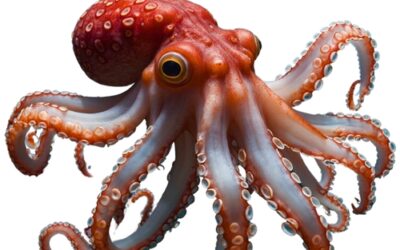
The octopus, meanwhile, survived. It could reconfigure its RNA to adjust its biology within hours rather than waiting for natural selection to reshape its DNA over generations slowly. While the ammonite’s success depended on stability, the octopus thrived on transformation.
Today’s corporations face their own asteroid moment. AI isn’t just another technology upgrade; it’s a fundamental rewiring of how value is created. Companies built like ammonites, with rigid hierarchies optimized for predictable environments, are discovering that their carefully constructed shells have become prisons.
Intelligence everywhere
The octopus’s anatomy is also instructive. It doesn’t route everything through a central brain. In fact, only a third of its neurons reside in its head. The rest live in its eight arms and the “neural necklace” that coordinates them. Each arm can taste, touch, and make decisions independently, yet they work in concert. It’s a distributed nervous system: intelligence everywhere, with the center setting the direction while the edges sense and respond.
This is precisely the model that AI-enabled organizations need to embrace.
Consider what this means in practice. At the insurance giant Travelers, AI-powered knowledge management doesn’t just make information searchable; it transforms how frontline staff work. Underwriters who once spent hours hunting for precedents and approvals can now synthesize specialized information at lightning speed. They can focus their time on making sophisticated decisions, understanding customer needs, and collaborating across functions. The company didn’t just add AI to old workflows. It redesigned the entire nervous system.
4 anatomical lessons from the octopus
The octopus offers four specific inspirations for organizational design:
1. The anatomy: 8 arms
The lesson: Push decisions to the edge.
The fastest way to bottleneck AI is to require executive approval for every choice or decision. Octopus arms act locally and in concert. In business, this means equipping frontline teams with real-time data, microbudgets, and clear risk parameters so they can solve problems in seconds rather than queuing them for weekly steering meetings.
2. The anatomy: A neural necklace.
The lesson: Wire context across silos.
When one octopus arm discovers something, the others know instantly. Organizations can achieve similar coordination when AI makes context transparent. AI can deliver the right information to the right person at the right moment, even if it has to structure that insight from messy, unstructured inputs. As a result, teams can sense second-order effects before they metastasize.
3. The anatomy: Three hearts.
The lesson: Switch leadership modes deliberately.
An octopus has three hearts because different conditions demand different circulation capabilities. Business leaders need analogous flexibility. For example, an “Analytic Heart” emphasizes evidence-based planning. An “Agile Heart” prizes rapid experimentation and autonomy. And an “Aligned Heart” sustains cultural cohesion and shared purpose.
Leaders who possess all three choose the right mode for the moment.
4. The anatomy: RNA-powered resilience.
The lesson: Rewrite processes faster than markets are moving.
Octopuses can edit their RNA to adapt rapidly. Firms need an equivalent, such as standing cross-functional crews empowered to change workflows, pricing, or distribution channels when market signals shift.
Most organizations freeze during shocks because their operational “DNA” is too rigid. Octopus Organizations reprogram their cores from within.
The path forward
An AI transformation sounds complex, but it begins with modest, concrete steps. This quarter, you can start by naming three recurring decisions you’ll decentralize. Publish the decision rights, establish guardrails, and fund them with microbudgets. Measure cycle time and experimentation rate, not just outcomes.
Establish your neural necklace by picking one cross-functional flow, such as new product development, and making its data searchable, tagged, and automatically pushed to the roles that need it. You don’t need a perfect data architecture; even a minimum viable approach can cut handoffs and meetings by half.
Then create a resilience crew: a small, cross-functional team with the explicit authority to alter workflows when key indicators cross predefined thresholds. Require this team to document every “RNA edit” with a one-page explanation of the change and its impact.
Finally, build the scaffolding. Launch initiatives against clear hypotheses, establish metrics, capture what you learn, and share these lessons. Hold teams accountable with a single question: What decision did this accelerate?
Beyond the hype
The AI conversation is dominated by either breathless enthusiasm or apocalyptic anxiety. Both miss what matters. The technology itself will keep improving — that’s the easy part. The hard part is organizational: rewiring decades-old structures so judgment happens at the edges, ideas don’t die in approval queues, and people treat AI as a multiplier of human coordination rather than a replacement for it.
Your industry’s asteroid is already in flight. The only question is whether you’ll be an ammonite or an octopus.