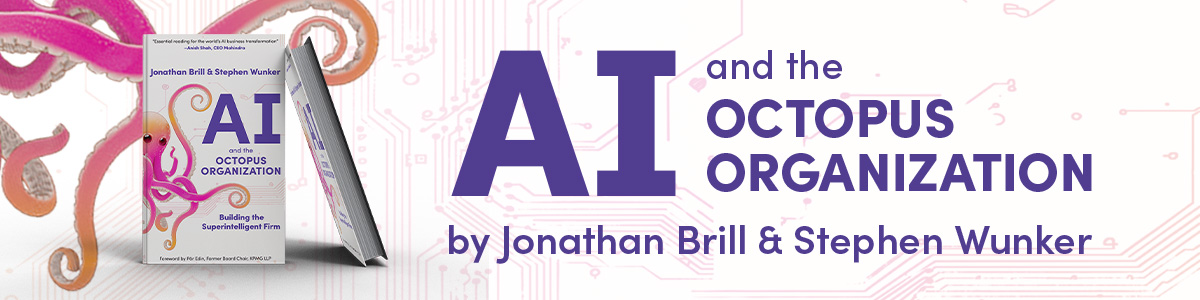
This is an English translation of the Canal CEO article “La lección inesperada de un pulpo” by Elena Carrascosa Vela, in which she reviews the book AI and the Octopus Organization: Building the Superintelligent Firm by Jonathan Brill and Steve Wunker.
Artificial intelligence is not just transforming tasks: it’s changing how companies are organized. The concept of the “octopus organization,” developed by Jonathan Brill and Stephen Wunker, proposes a model with distributed intelligence, agile decision-making, and human-AI collaboration.
For years, the business discourse on artificial intelligence has revolved around the same question: what can the technology do? But perhaps the truly uncomfortable question is something quite different: are companies organized to take advantage of it?
Jonathan Brill and Stephen Wunker formulate this quite clearly in their book *AI and the Octopus Organization* (Almuzara) . According to the authors, artificial intelligence is not just another tool in companies’ technological arsenal, but a capability multiplier that can transform how value is created, decisions are made, and how companies compete in the market.
The problem is that many organizations are still trying to apply this newfound power to structures designed for another era: rigid hierarchies, functional silos, and processes that concentrate decision-making at the top of the pyramid. It’s a model that worked reasonably well for decades, but it’s beginning to show its limitations in an environment where the pace of change is radically different.
Not surprisingly, despite the huge investment in artificial intelligence, only around 26% of companies have obtained significant value from their AI initiatives , according to data collected by the authors.
Perhaps the problem isn’t the algorithms. Perhaps it’s the architecture of the organizations.
Do you still function with only one brain?
The metaphor Brill and Wunker propose to explain this change is as simple as it is suggestive. If one observes the workings of an octopus, one discovers something surprising: its intelligence is not centralized in a single brain . A significant part of the processing occurs in its own tentacles, which can explore, react, and solve problems relatively autonomously while maintaining overall coordination with the rest of the organism.
This combination of distributed intelligence, flexible coordination, and rapid adaptation is what inspires what the authors call the Octopus Organization™ . It’s a model in which routine decision-making is distributed, silos are broken down, and teams can act more quickly in the face of disruption.
Instead of relying on a single command center, the organization develops multiple nodes capable of interpreting information, experimenting, and responding to the environment. This is especially relevant when artificial intelligence can amplify human judgment at every point in the system.
In a way, the octopus metaphor echoes an idea that management theorist Peter Drucker anticipated decades ago: the organizations of the future would be less hierarchical and more based on distributed knowledge . The difference is that now artificial intelligence acts as a catalyst for that transition.
Humans and machines thinking together
One of the most interesting insights in the book is that the true potential of AI lies not in replacing people, but in redesigning how they work together.
The octopus-like organization proposes empowering the front line—where many of the real business problems occur—through artificial intelligence tools that enhance judgment and decision-making capabilities. Simultaneously, the company is building cross-departmental coordination networks that enable faster execution.
It’s not just about technology. It also involves cultural changes.
The authors discuss creating cultures of safe experimentation , with clear metrics and spaces where teams can test new ideas without each failed attempt becoming an internal political issue. In this context, AI ceases to be an isolated project and becomes part of the organization’s operating system.
This approach connects with something that economist and thinker Herbert Simon already pointed out decades ago: organizations exist, to a large extent, to amplify the decision-making capacity of individuals in the face of environmental complexity . Today, that amplification can occur through collaboration between humans and intelligent systems.
The emotional side of change
However, reorganizing a company is never a purely technical exercise. Brill and Wunker insist that a significant part of this transformation involves managing the emotions that technological change provokes: uncertainty, internal resistance, and the fear of losing professional relevance.
Therefore, the book devotes particular attention to the skills that managers will need in this new scenario: judgment, communication, and organizational design skills that enable them to create roles, incentives, and processes adapted to a distributed intelligence environment.
The challenge is significant. Transforming a company involves redesigning power structures, responsibilities, and ways of working that have been established for decades. But it also opens up an interesting possibility: that organizations become smarter precisely because they know how to make better use of technology.
The real disruption
Jonathan Brill sums it up with a provocation that should make more than one management committee uncomfortable: the next disruption will not be technological, but organizational.
Artificial intelligence models are evolving at an almost unimaginable pace—some experts estimate that their cost could drop dramatically in the coming years while their capabilities multiply. But the real competitive advantage will likely come not from who has access to the technology, but from who is best able to organize themselves to use it .
The tools already exist. What’s lacking, as the authors point out, is organizational imagination. And perhaps that’s why the future of management doesn’t resemble a pyramid so much as something far more flexible, distributed, and dynamic.
Something, for example, similar to an octopus.
Click here to see the original article in Spanish
Available Now: